
We got here by asking better questions.
Silver Stone Apothecary got its start at local markets and events in Oregon, which meant that from the beginning we were talking to the people using our products almost as quickly as we could make them. Someone would tell us what their hair was doing, what they had already tried, what kept going wrong, and what they wished a product would do differently. In those early years, those conversations shaped the line almost in real time.
The more people we talked to, the more obvious something became: the first answer is almost never the whole answer.
Someone says their hair is dry. Okay, but does it get weighed down easily? Their roots are oily. How quickly does that happen, and what are their ends doing? They have 3B curls. Great, but that still doesn't tell us what their scalp needs, how much moisture their strands can handle, or whether their biggest styling problem is frizz, flatness, or curls that don't last.
Those are the kinds of questions we've been asking at markets for years. As Silver Stone Apothecary grew, we didn't leave those conversations behind. We built around them. Today, the way we formulate, recommend products, teach about curls, and troubleshoot routines has been shaped by tens of thousands of individual conversations with real curly-haired people.
Eventually all of that listening turned into a very simple way of thinking about curls: scalp, strands, style.
HOW WE THINK ABOUT CURLS

We make products for the way curls actually behave
Real curly hair doesn't fit neatly into a chart. Dry hair can still be fine and easily flattened. An oily scalp can exist with dry lengths. Coarse strands can hate certain heavy products. Someone can get beautiful curl clumps out of the shower and still lose all of that definition a few hours later.
That's why our products aren't built as rigid matching systems where everyone with one type of curl gets the same shampoo, conditioner, and styler. We formulate each product to do a specific job, then help you put those pieces together around your hair. Sometimes that means a lighter conditioner with a strong-hold gel. Sometimes it means a scalp-focused shampoo with a richer conditioner. Sometimes the thing your curls need most isn't more moisture at all. We'd rather understand the problem first.


We formulate our own products
HOW WE FORMULATE
Silver Stone is a formulator-led company. Angela develops our formulas here in Oregon and chooses ingredients based on what they actually contribute to the finished product. Safety matters, performance matters, sourcing matters, and sustainability matters. When there's a plant-derived alternative to a petroleum or animal-derived material that works as well or better, we actively look for it.
But the finished product still has to do its job. A shampoo bar shouldn't leave your hair feeling like straw just because it saves a plastic bottle. A conditioner should actually condition. And if a gel is supposed to carry your curls through a humid day, it needs to hold up when the weather gets ugly.
Customers have told us plenty of stories about shampoo bars that left their hair feeling chalky or stripped. Our answer has always been that a bar still needs to be properly formulated for hair, including the right pH and conditioning ingredients. Every ingredient has a job, and if it doesn't make the formula meaningfully better, it probably doesn't need to be there.


And then we make them here
Our products don't leave the formulation bench and disappear into somebody else's factory. We manufacture them ourselves in Oregon, and we intend to keep it that way.
Chris leads production and the team working alongside him, which keeps formulation and manufacturing unusually close together. If something needs to change, the people developing the formula and the people making it can solve it together.
But keeping manufacturing in-house matters to us for another reason too. Outsourcing production would be easier in some ways. We could send more of the work somewhere else, including overseas, and let another company build the capacity for us. We'd rather build that capacity here. We want Silver Stone Apothecary getting bigger to mean more jobs in our community, more people learning useful skills, and more opportunities for people to build something with us.
That philosophy shows up in our sourcing too. When we can buy packaging domestically, we do, and some of our boxes are produced as close as Springfield, Oregon. We don't assume the nearest supplier is automatically the best choice, but when quality, performance, and cost make sense, we'd rather keep that spending closer to home.
THE PEOPLE BEHIND SILVER STONE APOTHECARY
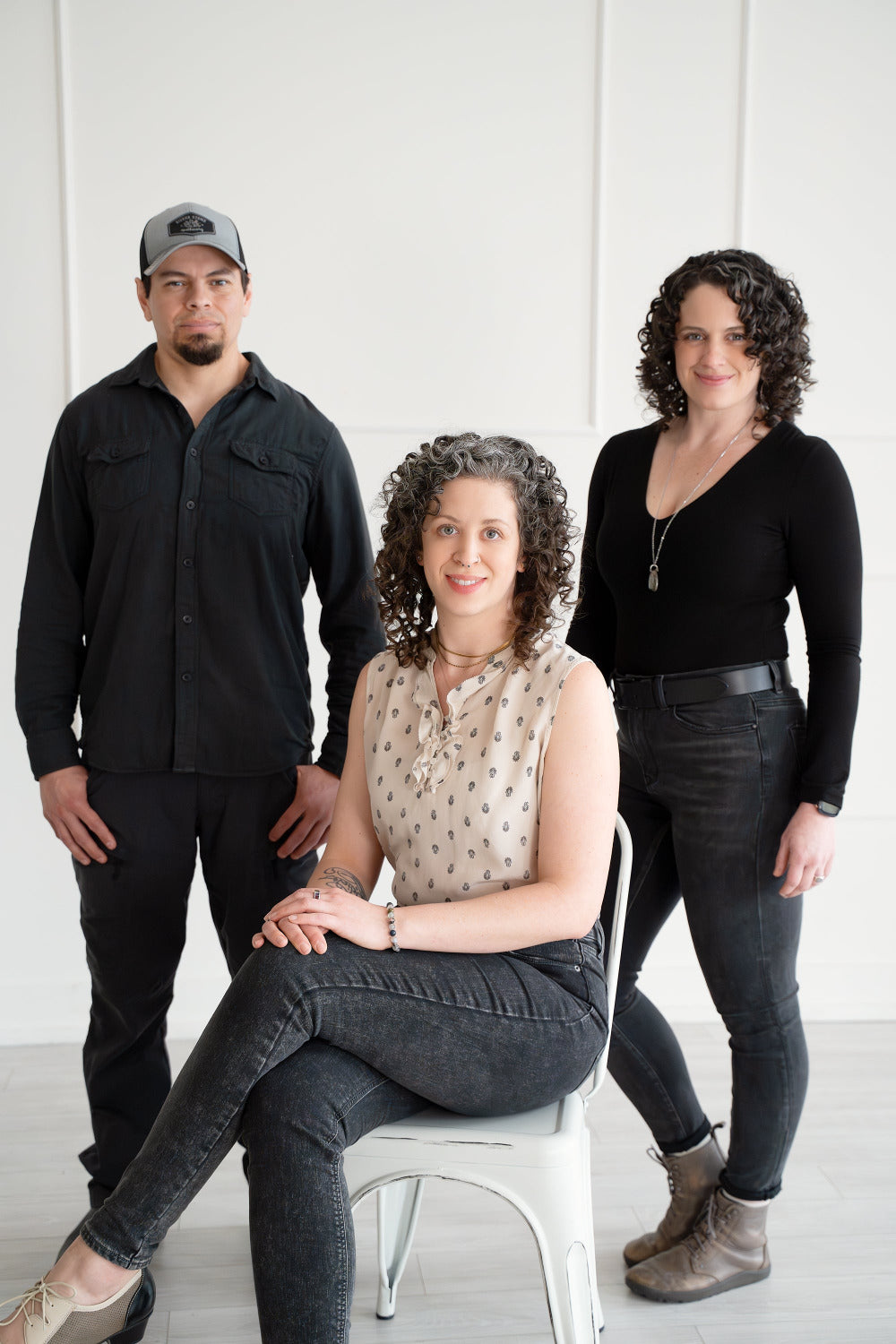

From left to right: Chris Mayorga, Brenna Rupe, Angela Mayorga
Silver Stone Apothecary is still a small company, which means we work closely together with a lot of overlap
Angela founded Silver Stone Apothecary and envisions where it goes next. She's behind the formulas, the way we think about curls, and the bigger decisions that shape the company. Her days tend to move between the long view and the extremely practical, whether that's developing a product, talking curls with a customer, directing the next marketing project, or figuring out what Silver Stone Apothecary needs before its next stage of growth.
Chris turns those ideas into something we can actually make, consistently and at scale. He leads manufacturing and production, with a particular talent for taking something that works at the formulation bench and figuring out how to make it work hundreds of times in the shop. He is what makes the ideas a reality.
Brenna helps turn direction into momentum. As our Operations and Growth Partner, she connects a lot of the moving pieces that keep Silver Stone Apothecary progressing, turns plans into repeatable systems, and helps make sure good ideas actually make it out into the world.
Around the three of us is a growing team helping with production, fulfillment, markets, and events, including ambassadors representing Silver Stone Apothecary farther from home.
The work is deeply connected. A customer question can become a better explanation on the website. A repeated frustration can turn into a product idea. A formulation change can move directly into production. A growth opportunity can expose a system we need to build before we get bigger. The distance between the customer, the people making the decisions, and the people making the products is still very short here, and we want to keep it that way.


Our customers are part of the process
The markets where Silver Stone Apothecary began taught us something we never want to lose. You learn a lot when someone is standing in front of you describing exactly what their hair did that morning.
Over the years we've heard nearly every combination imaginable. "My hair is dry, but everything weighs it down." "My roots get oily, but my ends are so dry." "My curls look amazing in the morning and fall apart by dinner." "I can get the curls, I just can't keep them."
That last part matters, because our customers don't just tell us whether they like a product. They help us understand the problems worth solving.
Those conversations have influenced our formulas, our education, our quiz, our product recommendations, and the way we teach our event ambassadors to help people. Our event approach is still built around asking questions before recommending anything and helping people understand how product choice and technique work together.
As we've grown beyond local markets, we've built new ways to keep listening through email, reviews, surveys, the quiz, social media, and the questions people send us every day. The scale has changed. The feedback loop hasn't.


We don't expect curls to follow a rulebook
take the quiz
And we don't think you should have to either. Sometimes your hair needs more moisture. Sometimes it needs less weight. Sometimes it needs more structure or stronger hold. Sometimes you need a different shampoo. And sometimes the product you already own is fine and changing how you use it makes all the difference.
We'd rather help you understand why your curls are behaving the way they are than hand you another set of rules to follow. That's what Silver Stone Apothecary has become after all those batches, all those market weekends, and all those conversations: a company that formulates, makes, listens, learns, and keeps asking better questions.
Ready to figure out what your curls need?